

Complete Guide to Marketing Automation and Lead Generation: Strategies, Tools, and Benefits for Business Growth
Marketing automation streamlines repetitive marketing tasks and orchestrates automated lead generation across channels to capture, qualify, and convert prospects more efficiently. This guide explains how marketing automation works, which lead generation automation strategies drive the best results, how to select marketing automation software, and how AI and measurement practices improve conversion rates and ROI. Many teams struggle with inconsistent lead quality, disconnected data, and slow handoffs to sales. Marketing automation addresses these issues by standardizing workflows, applying lead scoring models, and integrating CRM data for faster decision-making. In the sections that follow, you’ll get practical workflows and decision checklists, comparisons of platform feature sets, AI-driven personalization tactics, compliance and ethical safeguards, and a KPI-driven optimization cadence to sustain growth. Throughout the article, we use concepts like automated lead generation, lead nurturing workflows, predictive lead scoring, CRM integration, marketing automation, and marketing automation ROI to connect strategy with tools and implementation. By the end, you’ll have a clear playbook for building automated marketing campaigns that generate higher-quality leads and measurable pipeline impact.
What is Marketing Automation and How Does It Enhance Lead Generation?
Marketing automation is a set of technologies and workflows that execute marketing tasks automatically to improve lead capture, qualification, and conversion by using triggers, segmentation, and personalized outreach. It enhances lead generation by delivering timely, relevant interactions—such as automated email sequences and behavior-triggered messages—that increase engagement and move prospects through the funnel more efficiently. The mechanism combines workflow builders, segmentation rules, and content personalization, ensuring that each lead receives contextually appropriate touchpoints based on their behavior and profile. Below are concise benefits that capture how automation improves outcomes for acquisition teams.
Marketing automation’s core components include workflow editors, segmentation engines, content templates, and analytics dashboards that together create repeatable processes for lead capture and nurturing. These components reduce manual tasks and ensure consistent follow-up, which lowers lead leakage between marketing and sales. Understanding the parts of automation lays the groundwork for the next topic: defining each component and illustrating a brief example workflow.
Marketing automation provides measurable improvements by applying lead scoring and routing logic that identifies high-propensity leads, surfacing them to sales, thereby increasing conversion rates and reducing sales cycles. As we explore these components in more detail, the connection between technical features and business outcomes becomes clearer.
Defining Marketing Automation: Key Components and Processes
Marketing automation is composed of modular capabilities—workflow builders, segmentation, triggers, personalization engines, templates, and analytics—that combine to automate how leads are engaged and progressed. Workflow builders enable teams to design sequences of actions (emails, SMS, ad syncs, list updates) that fire based on triggers such as form submissions, page views, or inactivity. For example, a lead magnet download can trigger a timed drip campaign that introduces product benefits and invites a demo. Segmentation creates targeted groups based on firmographics or behavior, while personalization engines tailor Content using dynamic fields and content blocks to increase relevance. Analytics tracks engagement and campaign performance to inform testing and optimize content cadence.
These components operate as a system: triggers move leads into segments, workflows deliver tailored Content, personalization increases engagement, and analytics close the feedback loop. This system-level view leads directly to examining how automation improves lead quality and conversion rates through specific mechanisms like scoring and timely outreach.
How Marketing Automation Improves Lead Quality and Conversion Rates
Marketing automation improves lead quality by combining explicit attributes (company size, job title) and implicit signals (page views, email engagement) into lead scoring models that prioritize high-value prospects for sales. Behavioral triggers enable immediate, contextual follow-up—such as sending a case study after viewing pricing—that increases relevance and reduces time-to-contact, which empirical evidence and best practices indicate lifts conversion rates. Personalization based on segment and score increases response rates because messages align with the lead’s stage in the customer journey, and routing rules ensure that sales resources focus on SQLs, thereby improving pipeline conversion efficiency. Together, scoring, timely engagement, and personalization create a virtuous cycle where higher-quality leads receive better-focused outreach, and conversion metrics improve as a result.
Understanding these mechanisms helps inform strategy choices across channels, which is the next major topic: selecting the highest-impact automated lead generation strategies for your funnel.
Which Lead Generation Automation Strategies Drive the Best Results?
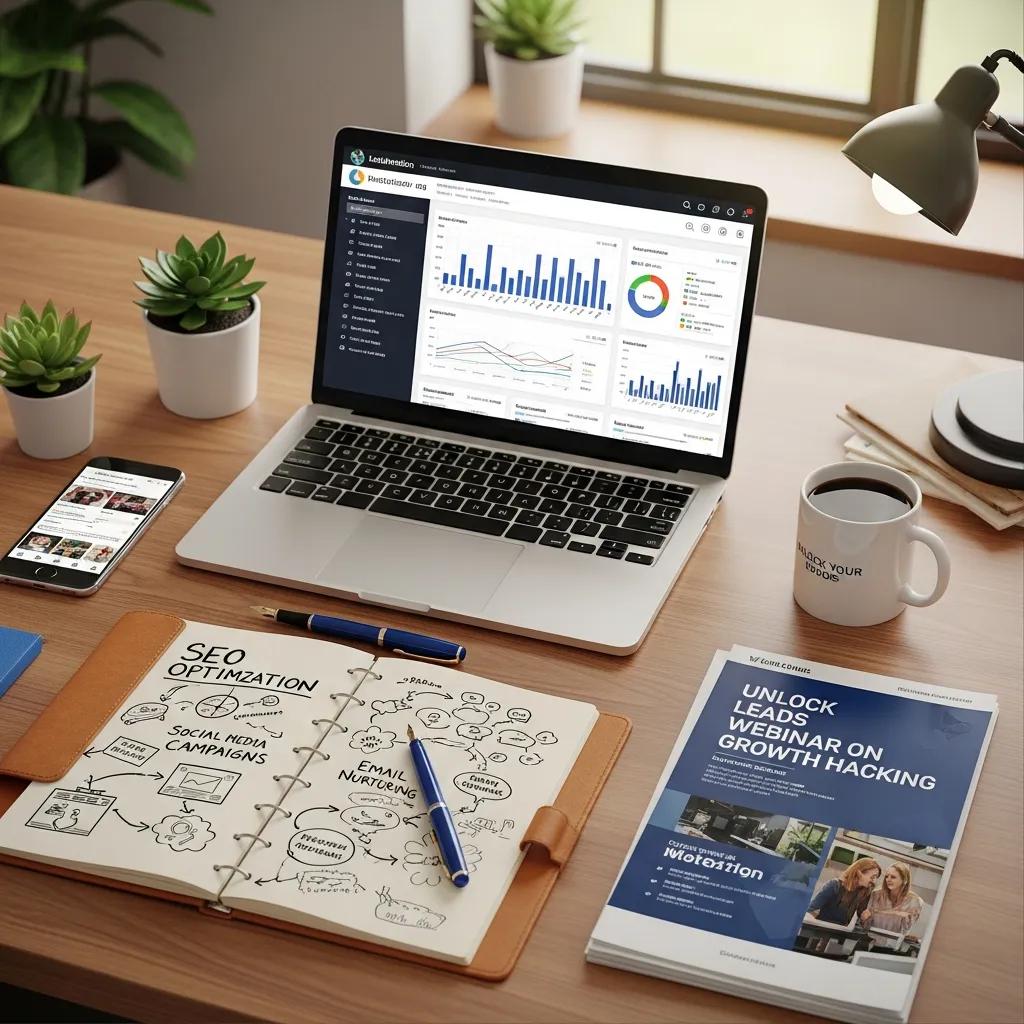
High-impact lead generation automation strategies combine Content, behavior-based triggers, and cross-channel amplification to increase both lead volume and lead quality. Top approaches include content-gated lead magnets that feed drip campaigns, behavioral-triggered outreach for intent signals, retargeting ads to re-engage warm prospects, and conversational capture (chatbots) to qualify leads in real-time. Selecting a mix depends on funnel stage and resources: use gated Content and SEO to broaden top-of-funnel reach, automated email drips to nurture MQLs, and retargeting plus chat to accelerate mid-funnel conversions. Below is a practical enumeration of the most effective strategies and how they typically perform.
Below is a quick comparison table that maps the primary strategies to their respective channels and expected outcomes, helping to prioritize investments.
How to Design Effective Automated Lead Nurturing Workflows
Designing an effective nurture workflow begins with mapping buyer journeys, defining goals for each stage, and selecting triggers and Content that move leads toward conversion.
- Step 1: Map the customer journey and identify the critical actions that indicate intent
- Step 2: Segment audiences by intent and fit
- Step 3: Design a sequence of content types (educational, social proof, product demo) with timing rules
- Step 4: Set scoring thresholds and routing rules for sales handoff
- Step 5: Implement testing and monitoring to refine cadence and messaging
An example sequence might start with a welcome email after a download, followed by a problem/solution case study on day 3, a product demo invitation at day 7 if engagement exceeds a threshold, and a sales alert when the lead score surpasses the SQL threshold.
Include A/B tests for subject lines and send times, and ensure that every workflow has a clear conversion event and a corresponding measurement plan. These design steps to ensure accuracy flow naturally into lead scoring best practices, which underpin routing and qualification.
What Are the Best Practices for Lead Scoring and Qualification?
Lead scoring balances explicit firmographic signals (company size, industry, role) with implicit behavioral signals (page views, content downloads, email clicks) to create a composite propensity score that guides routing and prioritization. Best practices include assigning weighted values to actions (e.g., pricing page visit > blog read), setting clear thresholds for MQL and SQL, and periodically reviewing and recalibrating scores against closed-won data. Integrate scoring with CRM processes, so sales receive contextual notes, and establish rules that prevent score inflation from spammy behavior; for example, using frequency caps or decay logic for older actions.
A simple scoring rubric helps teams operationalize this approach:
- . Each category offers: Assign points for firmographics and declared intent.
- Implicit Signals: Award points for engagement events and frequency
- Routing Rules: Define MQL → SDR → AE flows based on thresholds
These practices ensure scored leads are meaningful and actionable, and they lead to the practical question of which platforms provide the features to implement them effectively.
What Are the Top Marketing Automation Software Solutions and Their Features?
Marketing automation software falls into categories—SMB-focused platforms, enterprise suites, CRM-integrated all-in-one systems, and niche point solutions—each offering variants of workflow editors, integration connectors, reporting, and personalization capabilities.
Essential features to evaluate include a visual workflow builder, native CRM integration, lead scoring and routing, personalization engines, multi-channel orchestration (email, ads, SMS, chat), and analytics that support attribution and pipeline reporting.
Decision criteria should prioritize integration connectors for your CRM and ad platforms, ease of use for your team, and the quality of analytics for automated lead generation and campaign optimization.
Below is a comparison table to match platform characteristics to business use cases.
This comparison enables teams to match platform classes with common use cases and scale requirements.
When comparing platform features, consider RevUp Now’s positioning: RevUp Now is a company focused on providing solutions related to marketing automation and lead generation, likely offering a suite of services such as automated email campaigns, lead scoring, CRM integration, content syndication, and advanced analytics, emphasizing increased efficiency and data-driven decision making. This positioning illustrates how a vendor can combine integrations and analytics to support scalable growth.
The next subsection outlines how to choose and pilot a platform before full rollout.
How to Choose the Best Marketing Automation Software for Your Business
Choosing the right software starts by documenting your core use cases, must-have integrations, and team capacity, then scoring vendors on those criteria during an RFP or pilot phase. Prioritize platforms that natively connect to your CRM and ad accounts, offer a user-friendly workflow editor for marketers, and provide reporting that ties automation to pipeline metrics. Run a 4–8 week pilot focused on one revenue-driving workflow—measure engagement lift, lead-to-MQL conversion, and lead routing accuracy—and use those metrics to inform full rollout decisions. Include governance, enabling user roles, data settings of automation, and integration error handling in your evaluation checklist.
A targeted pilot reduces risk and clarifies ROI expectations, and it naturally leads to the benefits of CRM integration covered next.
What Are the Benefits of CRM Integration with Marketing Automation?

CRM integration creates a single source of truth by synchronizing contact, account, and opportunity data so marketing automation can both recognize and write actions that influence the pipeline. Benefits include improved lead routing, consolidated attribution for marketing, real-time, and improved creation of duplicate records, and faster sales follow-up when a lead meets SQL criteria.
Best practices for integration include:
- Mapping fields clearly
- Controlling sync frequency to avoid latency
- Handling duplicate detection rules
- Ensuring consent flags and data privacy markers flow between systems
Common pitfalls include one-way syncs that lead to data drift and poorly mapped custom fields, which can break automation logic.
Addressing these integration considerations strengthens closed-loop reporting and enables teams to measure automation impact reliably, which is the focus of the measurement and optimization section that follows.
How Does AI Enhance Marketing Automation and Lead Generation?
AI enhances marketing automation by powering predictive lead scoring, dynamic content personalization, and automated campaign optimization that allocates budget across channels more efficiently. Predictive models analyze behavioral and firmographic inputs to surface high-propensity leads earlier, while personalization engines use engagement history to assemble customized messaging and content variants in real time. AI can also optimize send times, creative selection, and ad bids to improve campaign ROI, turning raw behavioral data into actionable orchestration across automated marketing campaigns. The net effect is smarter, faster lead qualification and more relevant automated outreach that raises conversion rates.
These AI applications rely on explainable inputs and monitoring to ensure ethical use and maintain customer trust; the next subsections describe predictive scoring mechanics and ROI improvements in practical terms.
What is AI-Powered Personalization and Predictive Lead Scoring?
AI-powered personalization combines inputs—behavioral events, engagement recency, firmographics, and historical outcomes—to predict content variants and the likelihood a lead will convert, then serves tailored Content or nudges accordingly. Predictive lead scoring trains models on past conversion data to assign propensity scores that more accurately reflect future behavior than rule-based scores alone, often incorporating decay functions and interaction effects between features. Inputs typically include page views, email interactions, company attributes, and prior conversions; outputs are propensity scores and content recommendations that inform automated email sequences or sales outreach. Using thresholding, teams can route leads with high propensity scores directly to sales and keep lower scores in longer nurture tracks.
Predictive scoring and personalization increase efficiency by focusing high-touch efforts where they matter most, which in practice translates into measurable improvements in campaign performance and ROI.
How Can AI Improve Automated Campaign Performance and ROI?
AI improves campaign performance by automating segmentation, optimizing creative selection through multivariate testing, and reallocating budget toward higher-performing audiences and channels based on real-time signals. For example, algorithms that optimize send times can raise open and click rates, and automated bidding strategies can lower cost-per-acquisition while maintaining conversion volume. Recent industry analyses in 2023–2024 show that AI-driven personalization and optimization can boost conversion rates by double-digit percentages in many B2B and B2C contexts, although results vary by data quality and implementation. A hypothetical ROI example: improving MQL→SQL conversion by 15% via predictive scoring can reduce CAC by allocating sales time more efficiently, thereby improving pipeline velocity and revenue per marketing dollar.
These performance gains depend on clean data, careful model validation, and ethical guardrails—topics that lead into the benefits and ethical considerations section next.
What Are the Benefits and Ethical Considerations of Marketing Automation?
Marketing automation delivers efficiency, consistency, and scale by automating repetitive tasks, ensuring timely multi-channel follow-up, and enabling personalized engagement across the customer journey. Operational benefits include time savings for marketing and sales teams, predictable outreach cadence, and the ability to scale lead nurturing without linear increases in headcount. However, ethical considerations and data-privacy obligations—under frameworks like GDPR and CCPA—require consent management, data minimization, transparent personalization, and mechanisms for data subject rights. Balancing automation benefits with privacy protections preserves customer trust and reduces regulatory risk.
How Does Marketing Automation Increase Efficiency and Customer Engagement?
Marwhat’s automation increases efficiency by removing manual follow-up tasks, standardizing campaign execution, and enabling multi-touch sequences across channels with minimal manual intervention. Automation reduces lead response times—using behavior triggers to send engagement messages instantly—which research indicates is a key driver of conversion uplift. Personalization and segmentation further increase customer engagement by serving relevant Content that matches intent and funnel stage, improving open and click-through rates. Teams that automate routine nurturing free up time for strategic initiatives like creative testing and cross-channel orchestration, which compounds gains in pipeline velocity and marketing-attributed revenue.
These efficiency gains directly inform how organizations should approach privacy and ethical use of data as automation scales, which the next subsection addresses.
What Are the Data Privacy and Ethical Practices in Marketing Automation?
Practical privacy and ethical practices include capturing explicit consent where required, minimizing collected personal data to what’s necessary for the intended purpose, enabling easy opt-outs, and maintaining transparent personalization disclosures.
- Implement a consent management platform or flags within your CRM that travel with contact records and are respected by automation rules
- Retain audit logs for processing activities and provide mechanisms for data access and deletion requests
- For AI-driven personalization, adopt explainability practices—documenting which inputs affect model outputs—and monitor models for bias or unintended behavior
This compliance-first mindset supports long-term program sustainability and helps prepare teams for measurement and optimization practices discussed next.
How to Measure and Optimize Marketing Automation and Lead Generation Success?
Measuring automation success requires tracking a mix of volume and quality KPIs, establishing attribution models that credit automation for pipeline contributions, and running iterative tests to improve campaign effectiveness. Core metrics include lead volume, MQL→SQL conversion rate, time-to-contact, pipeline velocity, customer acquisition cost (CAC), lifetime value (LTV), and automation-attributed revenue. Reporting should combine engagement dashboards with closed-loop CRM data to quantify how automated campaigns influence revenue outcomes. Below is a KPI cheat-sheet table to act as a practical tracking reference for automation ROI.
This KPI set guides measurement and informs optimization tests like segmentation experiments and send-time optimizations.
Which KPIs don’tetrics Are Essential for Tracking Automation ROI?
Essential KPIs tie activity to business outcomes: lead volume shows input, MQL→SQL conversion indicates quality, pipeline velocity and average deal size reflect revenue impact, and CAC/LTV frame long-term economics. To track ROI, align marketing campaign touchpoints with CRM opportunity creation and revenue attribution—use consistent tagging and a defined attribution model (first-touch, last-touch, or multi-touch as appropriate). Establish realistic benchmarks by vertical and company size and monitor trends rather than isolated data points; for example, a rising MQL→SQL rate paired with stable lead volume indicates improved lead quality. Regularly validate that lead scoring thresholds correlate with closed-won outcomes to keep predictive signals aligned with business performance.
As an implementation example, RevUp Now offers analytics and integration-focused services aimed at helping businesses succeed by tying automation to revenue through advanced analytics and CRM integrations, providing a practical partner option for teams that need implementation support.
What Are the Best Practices for Continuous Campaign Optimization?
Continuous optimization follows a test → measure → refine cadence with clear hypotheses, controlled experiments, and data hygiene practices to ensure valid results.
- Define hypothesis
- Select metric
- Segment audience
- Run test
- Analyze results
- Roll out or iterate
Implement a prioritized experiment backlog (subject line A/B tests, segmentation splits, send-time variations), run statistically meaningful tests, and maintain clean lists by removing inactive contacts and consolidating duplicates. Governance ensures experiments don’t conflict—use naming conventions, version control for workflows, and a central experiment log. Adopting this disciplined optimization approach yields steady improvements in automated campaign performance and sustained increases in marketing efficiency. For teams seeking support, RevUp Now can act as an implementation partner to set up dashboards, refine attribution, and operationalize optimization workflows that focus on measurable business outcomes.
Conclusion
Implementing marketing automation can significantly enhance lead generation by streamlining processes, improving lead quality, and increasing conversion rates. By leveraging AI-driven insights and personalized outreach, businesses can achieve measurable growth while maintaining customer engagement. To explore how these strategies can transform your marketing efforts, consider reviewing our comprehensive resources or contacting our team for tailored solutions. Start optimizing your lead generation today and unlock the full potential of your marketing automation efforts.