
How AI and Automation Transform Business Growth Strategies with AI Agents for Service Businesses
AI Agents are autonomous software entities that perceive data, make decisions, and execute tasks to drive measurable business outcomes; they enable growth by automating routine work, improving responsiveness, and freeing staff for higher-value interactions. This article explains how AI and automation reshape lead generation, customer support, operations, and ROI for service businesses, using practical frameworks and implementation steps you can apply. Readers will learn what AI Agents are, how they differ from traditional automation, the specific ways they boost lead conversion and customer satisfaction, and how to measure returns in concrete terms.
Pain points such as slow lead response, inconsistent support, and high operational costs are addressed with tactical automation strategies and sample metrics to track. We also map an implementation roadmap—discovery, pilot, scale—and include practical checklists, EAV tables, and lists that clarify decisions for managers, operations leaders, and growth teams. Throughout, targeted phrases like AI for business growth, business process automation, and AI Agents for service businesses appear naturally to align with modern search intent and semantic relevance.
What Are AI Agents and How Do They Drive Business Transformation?
AI Agents are programmatic virtual assistants that ingest signals, apply decision logic, and perform actions across channels to complete business workflows automatically. They work by combining data intake, predictive models, natural language understanding, and execution hooks that trigger tasks or escalate to humans when needed, producing faster outcomes and consistent service delivery. The result is continuous, context-aware operation that reduces manual overhead and provides 24/7 availability for customer-facing and backend processes. Understanding this capability clarifies why many service businesses prioritize AI Agents as a core element of growth automation and operational transformation. This practical definition leads directly into the concrete operational roles AI Agents play across service workflows.
How Do AI Agents Automate Service Business Operations?
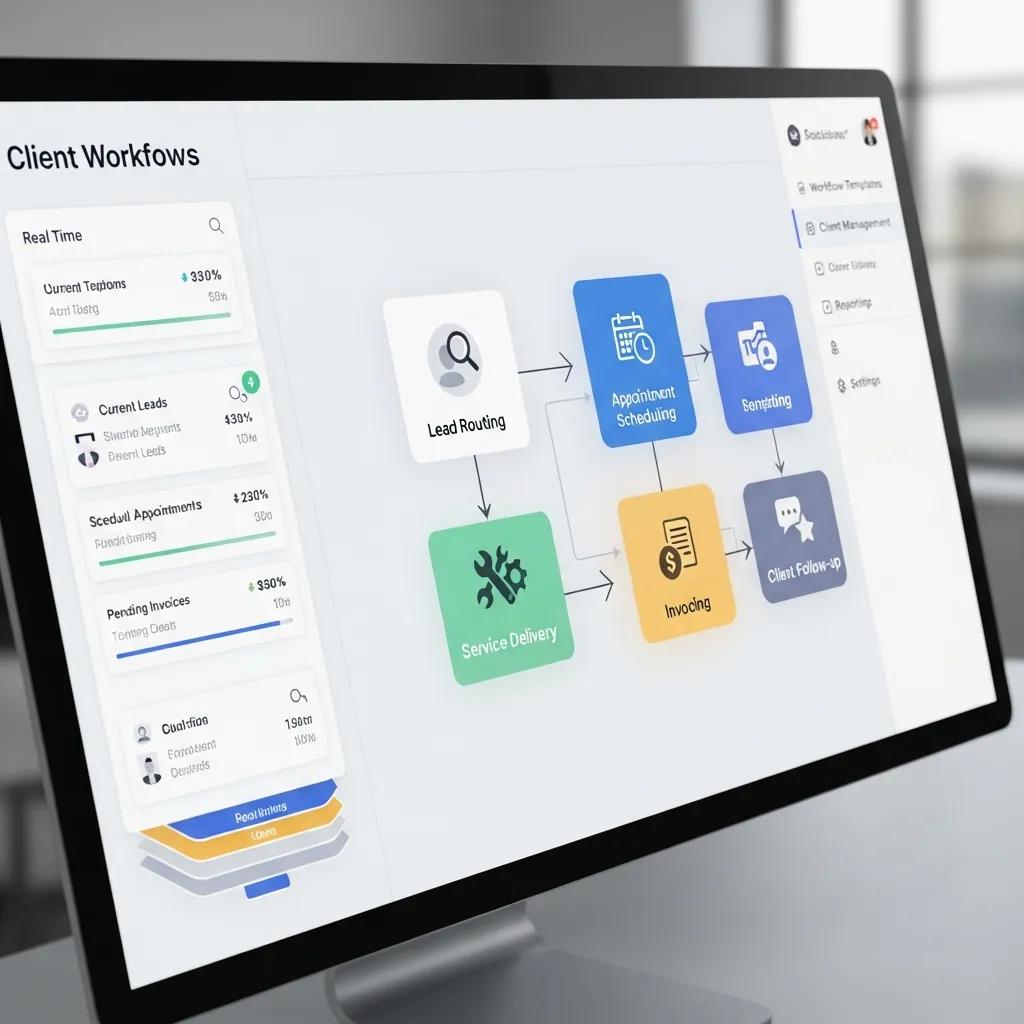
AI Agents automate high-frequency, rule-based, and adaptive tasks such as lead routing, appointment scheduling, invoicing, and follow-up workflows by linking triggers to reusable task templates and decision rules. For example, an agent ingests a web lead (input), scores intent with an enrichment model (decision), routes the lead to the right salesperson or schedules an appointment automatically (action), and logs the interaction to CRM (outcome). This automated flow reduces manual triage time, shortens time-to-contact, and increases throughput without proportional headcount increases. Visualizing the workflow as trigger → evaluate → act → record makes it easy to identify automation points and measure impact on conversion and cycle time.
What Makes AI Agents Different from Traditional Automation?
Unlike static rule-based automation or basic RPA, AI Agents incorporate learning, context awareness, and natural language processing to adapt to new patterns and conversational inputs. They can generalize from past interactions to improve routing decisions, use predictive signals to prioritize high-value work, and maintain conversational context across multiple touchpoints, which reduces friction in handoffs between digital and human agents. Maintenance differs as AI Agents often require model retraining and data governance rather than only rule updates, but this investment yields greater scalability and adaptability over time. Recognizing these differences helps teams choose the right mix of RPA and AI depending on process complexity and change velocity.
How Do AI and Automation Enhance Lead Generation and Sales Growth?
AI and automation enhance lead generation by accelerating response times, improving lead qualification, and maintaining personalized follow-up sequences that increase conversion velocity. Mechanisms include automated lead enrichment, conversational qualification, priority routing, and sequenced outreach across email, SMS, and chat, all of which shorten the sales cycle and improve close rates. Measuring response time, lead conversion rate, and lead velocity provides direct insight into growth automation performance. These mechanisms form the basis for practical growth automation strategies that service businesses can implement to scale the pipeline without linear increases in sales headcount.
How Can AI Agents Improve Lead Qualification and Prospect Engagement?
AI Agents improve qualification by scoring leads in real time using intent signals and third-party enrichment, conducting conversational qualification via chat or SMS, and assigning next actions such as scheduling a demo or routing to a human rep. A typical flow: ingest contact → run score → ask three qualifying questions → auto-schedule or route based on threshold. Key metrics to monitor include qualification rate, average time-to-contact, and conversion-to-opportunity percentage. Using semantic scoring and conversational templates ensures that prospects receive timely, relevant interactions that increase engagement while preserving sales bandwidth for only the highest-probability deals.
What Are Effective Growth Automation Strategies Using AI Agents?
Effective growth automation strategies focus on high-impact, measurable activities that shift revenue outcomes without bloating headcount. Below is a compact list of proven strategies and measurement approaches to prioritize.
- Automated Lead Triage: Use intent scoring to prioritize top leads and route them instantly to sales for faster follow-up.
- Conversational Qualification Sequences: Deploy chat or SMS flows that gather qualifying data and schedule meetings automatically.
- Drip and Re-engagement Campaigns: Trigger personalized multi-touch sequences based on behavior signals to recover idle leads.
- Upsell and Referral Triggers: Detect expansion signals and initiate targeted offers or referral requests automatically.
These strategies produce measurable outcomes—faster response, improved conversion, and higher lead velocity—when paired with clear KPIs and iterative optimization.
In What Ways Do AI Agents Improve Customer Support and Experience?
AI Agents improve customer experience by providing consistent 24/7 responses, automating routine support tasks, and preserving context across escalations to human agents. They reduce first response times and repetitive manual work, enabling support teams to focus on complex issues that drive satisfaction and retention. Integration with CRM and support systems ensures a single source of truth so that virtual assistants and human agents share the same interaction history. These improvements translate into predictable operational savings and uplift in CSAT and NPS when implemented with measurement and escalation safeguards.
How Do AI-Powered Chatbots Provide 24/7 Customer Service?
AI-powered chatbots handle common requests—FAQ answers, booking, status updates, and simple troubleshooting—by mapping intents to workflow actions and preserving conversational context across touchpoints. When a chatbot detects complexity or negative sentiment, it escalates with full context to a human agent to avoid user frustration. Recommended KPIs include first response time, resolution rate, escalation rate, and average handle time; monitoring these metrics highlights where to tune intents and handoffs. Properly designed chatbots create continuity in customer experience while reducing repetitive ticket volume and response latency.
What Impact Does AI Automation Have on Customer Satisfaction?
AI automation delivers faster, more consistent service that typically increases customer satisfaction by reducing wait times and ensuring accurate, personalized responses. Recent studies and operational reports show that reduced time-to-first-response and consistent answer quality drive measurable CSAT and NPS improvements when automation preserves context and escalates appropriately. For service businesses, the combination of faster resolution and personalized follow-ups increases perceived reliability and trust, which supports retention and referrals. Tracking CSAT before and after automation deployments provides a clear signal of impact and areas for refinement.
How Does Business Process Automation Boost Operational Efficiency and Reduce Costs?
Business process automation (BPA) streamlines repetitive workflows—scheduling, billing, dispatch, and reporting—by removing manual steps and enabling scale without linearly increasing headcount. BPA improves accuracy, reduces processing time, and supports compliance through consistent execution and audit trails. Real-time dashboards and AI-driven alerts surface bottlenecks and enable continuous improvement, so teams can reallocate resources to revenue-generating activities. Understanding which processes yield the highest ROI helps prioritize automation investments and measure operational improvements.
Introductory list for common BPA opportunities:
- Scheduling and Dispatch Automation: Reduces manual coordination and travel time.
- Automated Billing and Invoicing: Cuts errors and accelerates cash flow.
- Backend Data Sync: Keeps CRM, accounting, and field systems aligned automatically.
What Are the Key Business Process Automation Benefits for Service Businesses?
BPA benefits include faster processing, fewer errors, and the ability to scale services without proportional headcount increases; these improvements directly affect margins and service reliability. By standardizing processes and applying decision logic, businesses reduce variability in customer experiences and improve forecasting accuracy. Compliance and auditability also improve because automated processes leave consistent logs and reduce human error. These benefits provide the foundation for more strategic investments in AI-driven analytics and process redesign.
How Do AI Agents Optimize Staffing and Inventory Management?
AI Agents apply predictive staffing and inventory optimization by analyzing historical demand, seasonality, and booking patterns to recommend shift schedules and reorder points. Predictive models estimate demand peaks, enabling managers to staff efficiently and reduce overtime while preventing stockouts through automated reorder triggers. In practice, this reduces carrying costs and improves on-time service delivery, which enhances customer satisfaction and operational margins. These optimizations feed back into scheduling and billing systems to create a closed-loop operational improvement cycle.
What Is the ROI of Implementing AI and Automation in Service Businesses?
Calculating ROI for AI and automation requires combining labor cost savings, conversion uplift, retention improvements, and reduced error rates into a coherent financial model. A simple ROI formula: (Annual Benefits − Annual Costs) / Annual Costs, where benefits include headcount-equivalent labor savings, revenue lift from faster lead response, and support cost reductions. Recent industry analyses indicate measurable reductions in support costs and faster lead response times as primary drivers of short-term ROI. Quantifying these elements helps prioritize pilots that deliver the most predictable returns.
Introductory explanation for ROI comparison and then a table of common use cases:
How Do AI Agents Contribute to Scalability and Productivity Boosts?
AI Agents enable scalability by performing repetitive tasks continuously, thereby increasing throughput per employee and allowing teams to reassign human labor to higher-value activities. For example, automating lead triage can allow a small sales team to handle many more qualified prospects with the same headcount, increasing productivity per FTE. Key KPIs include productivity per FTE, throughput, and conversion per lead; tracking these before and after deployment quantifies productivity improvements and supports scaling decisions.
What Recent Industry Statistics Support AI Adoption Benefits?
Recent industry reports through 2024 indicate accelerating adoption of AI in service sectors with consistent reports of efficiency gains, reduced support costs, and faster lead response times. Summarized stats:
- Adoption Growth: Increasing percentage of service businesses piloting AI Agents for customer-facing workflows.
- Efficiency Gains: Reported reductions in support costs range from 20–40% in early deployments.
- Lead Response Impact: Faster response times often correlate with 30–70% improvement in initial contact speed.
How Can Service Businesses Successfully Implement AI Agents for Growth?
Successful implementation follows a phased roadmap: discovery and KPI definition, pilot design with measurable success criteria, iteration based on data, and scale with governance and training. Change management, data readiness, and clear ownership are essential to avoid common pitfalls such as unclear KPIs or fragmented data sources. Pilot projects should be small, measurable, and directly tied to revenue or cost metrics so that successes can fund broader rollouts. This roadmap frames the practical steps teams need to operationalize AI Agents and embed automation into growth strategies.
Introductory checklist and EAV mapping:
What Are the Steps to Integrate AI Agents into Existing Workflows?
A structured integration checklist ensures smoother adoption: assess current processes and KPIs, prepare data and integrations, design a focused pilot, measure results, and iterate before scaling. Responsibilities typically include an automation owner, IT/integration support, and frontline SMEs for validation. Common pitfalls include insufficient data quality, unclear success metrics, and a lack of user training; addressing these upfront increases the likelihood of success. Clear timelines and responsibilities help maintain momentum from pilot to scale while ensuring measurable outcomes.
Checklist for Integration:
- Assess: Map processes and define KPIs to target.
- Prepare: Cleanse data and identify integration touchpoints.
- Pilot: Deploy a focused agent with measurable success criteria.
Following this checklist reduces risk and fosters organizational alignment as automation matures.
How Do Case Studies Demonstrate AI Agents Driving Business Growth?
Case summaries illustrate how targeted AI Agent deployments produce measurable results such as faster lead response, lower support costs, and higher customer satisfaction. For example, a service provider that automated lead triage saw significant reductions in time-to-contact and improved conversion rates, while another that implemented chat-driven appointment scheduling reduced no-shows and streamlined dispatch. These narratives highlight that success factors include clear KPIs, executive sponsorship, and iterative optimization. If teams apply these principles, pilots tend to produce replicable outcomes that justify scaling automation investments.
Integration note: RevUp Now empowers service businesses through custom, industry-specific AI solutions called “AI Agents” that are built to automate repetitive tasks, free staff for high-value interactions, and operate 24/7 without adding headcount.
Their industry-focused approach aligns agents to lead generation, customer support, and backend automation workflows and is designed to generate tangible outcomes like reduced support costs and faster lead response times.
This company example illustrates how specialized vendors can deliver tailored AI Agents that fit workflow nuances and accelerate measurable growth.